Are They Better Than Boil-and-Bite Guards?
Whether it’s hockey, soccer, basketball, lacrosse or another active sport, protecting your teeth should be part of your equipment, not just an afterthought.
A sports mouth guard helps cushion blows to the mouth and can reduce the risk of dental injuries such as chipped, broken or knocked-out teeth, as well as cuts to the lips, cheeks and gums.
But walking into a sporting-goods store can leave parents and athletes with another question:
Is a boil-and-bite mouth guard good enough, or is a custom mouth guard from a dentist worth it?
At Beamsville Smiles Family Dentistry, we provide custom-fitted sports mouth guards made specifically from impressions of your teeth. Unlike generic store-bought options, they are designed around your individual bite for a secure and comfortable fit.
Here’s how the different options compare.
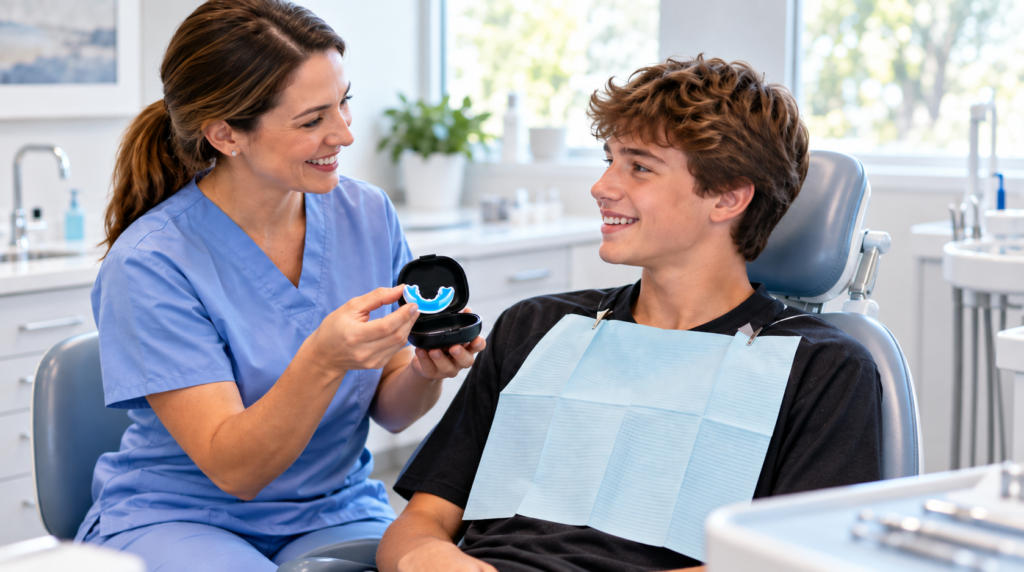
What Does a Sports Mouth Guard Actually Do?
A sports mouth guard creates a protective layer around the teeth and soft tissues of the mouth.
During a collision, fall or impact, the material helps absorb and distribute some of the force that would otherwise be directed toward the teeth and surrounding tissues.
Sports injuries can result in fractured teeth, displaced or knocked-out teeth, cuts inside the mouth and other dental trauma. A properly fitted mouth guard also helps protect the soft tissues around the mouth.
Mouth guards are therefore not just for professional or elite athletes. Children, teenagers and adults participating recreationally can all experience dental injuries.
What Are the Different Types of Sports Mouth Guards?
There are three main categories of sports mouth guards:
- Stock or ready-made mouth guards
- Boil-and-bite mouth guards
- Professionally custom-fitted mouth guards
A stock mouth guard comes preformed in a standard size. It is inexpensive and easy to purchase, but because it is not moulded to the individual athlete, it can feel bulky or loose.
A boil-and-bite mouth guard is softened in hot water and then shaped around the teeth by biting into the material. This gives it a more individualized fit than a stock guard, although it is still not fabricated from an exact model of the teeth.
A custom mouth guard is made using an impression or digital representation of the patient’s mouth so the appliance follows the shape of their individual teeth and bite.
Custom-made guards generally provide the most precise fit and can be adapted to the athlete’s particular sport and dental needs.
Custom Mouth Guard vs. Boil-and-Bite: What’s the Difference?
The biggest difference is precision of fit.
With a boil-and-bite mouth guard, the athlete moulds a prefabricated material at home. It can fit better than an unmoulded stock guard, but it is not formed from a model of the individual’s teeth.
A custom mouth guard is fabricated specifically for one patient.
That more precise fit can affect much more than comfort. A mouth guard that stays securely in position is easier to wear consistently and is less likely to feel like something the athlete constantly has to bite down on to keep in place.
For someone who practices or competes frequently, those small differences can become very noticeable.
Why Does the Fit Matter So Much?
The best mouth guard is one an athlete will actually wear properly.
If a guard is uncomfortable, bulky, loose or difficult to speak with, there may be a greater temptation to chew on it, remove it between plays or skip wearing it altogether.
A custom sports guard can be designed around the patient’s:
- Teeth
- Bite
- Mouth size
- Sport
- Age
- Orthodontic appliances, if applicable
That individualized approach is difficult to reproduce with a product designed to fit thousands of different mouths.
Which Sports Should You Wear a Mouth Guard For?
Hockey may be the first sport that comes to mind in Niagara, but mouth protection can be useful well beyond the rink.
Sports and activities where a mouth guard may be appropriate include:
- Hockey
- Lacrosse
- Football
- Basketball
- Soccer
- Baseball
- Rugby
- Wrestling
- Martial arts
- Gymnastics
- Skateboarding
- In-line skating
- Cycling
- Other activities where falls or contact are possible
Even sports that are not traditionally described as contact sports can involve an unexpected ball, stick, elbow, collision or fall.
If you are unsure whether your child or your particular sport warrants a mouth guard, ask your dentist about the level and type of risk involved.
Do Hockey Players Still Need a Mouth Guard With a Full Cage?
A hockey cage or face shield provides important protection, but it does not make a mouth guard unnecessary.
Head and face protection and mouth guards serve different purposes.
A cage can help protect the face from direct impacts such as sticks or pucks, while a mouth guard is positioned around the teeth and soft tissues inside the mouth.
For hockey families in Beamsville, it makes sense to think of a mouth guard as another piece of routine protective equipment alongside the helmet, cage and other required gear.
Are Custom Mouth Guards Better for Children?
Custom mouth guards can be particularly useful for children who participate in sports regularly because comfort and fit can influence whether the guard stays where it should.
However, children’s mouths change.
Baby teeth fall out, permanent teeth erupt, the jaw grows and orthodontic treatment may begin.
As these changes occur, a previously well-fitting mouth guard may eventually become too tight, too loose or otherwise unsuitable.
That means a custom mouth guard for a growing child should not simply be made once and forgotten.
Bring it to regular dental appointments so your dentist can check whether it continues to fit appropriately.
What If My Child Has Braces?
Athletes with braces still need dental protection.
In fact, braces can make a properly fitting mouth guard especially important because a blow to the mouth can injure the teeth while brackets and wires can also contribute to cuts or irritation inside the lips and cheeks.
Because the teeth are gradually moving during orthodontic treatment, the mouth guard needs to accommodate those changes.
If you or your child wears braces, let your dentist know before having a sports guard made so the appliance can be designed with the orthodontic treatment in mind.
Can a Mouth Guard Prevent a Concussion?
A mouth guard should primarily be considered protection for the teeth and mouth.
While mouth guards are an important piece of athletic equipment, they should not be treated as a replacement for sport-specific concussion prevention or appropriate head protection.
Helmets, cages, face shields and other protective equipment should continue to be used as recommended for the sport.
The primary purpose of a sports mouth guard is to help protect the teeth, gums, lips, cheeks and other oral structures from injury.
How Long Does a Custom Sports Mouth Guard Last?
There is no single replacement schedule that works for everyone.
An adult whose teeth and bite are stable may be able to use a well-maintained guard longer than a growing child or teenager whose teeth are changing.
The mouth guard should be inspected regularly for:
- Tears
- Cracks
- Significant wear
- Changes in shape
- Loose areas
- An increasingly tight fit
- Difficulty keeping it comfortably in place
Athletes who frequently chew on their mouth guards may also wear them out much faster.
A good habit is to bring the mouth guard to routine dental appointments so your dentist can check both its condition and fit.
How Should You Clean a Sports Mouth Guard?
Sports equipment gets sweaty, and mouth guards are no exception.
After wearing your guard:
- Rinse it with cool water.
- Clean it gently as recommended by your dental team.
- Allow it to air-dry.
- Store it in a clean, ventilated container.
- Keep it away from excessive heat.
Heat can distort some mouth guard materials and change the fit.
You should also avoid chewing on the guard, as repeated chewing can damage the material and reduce the lifespan of the appliance.
Is a Sports Mouth Guard the Same as a Night Guard?
No.
Although the two appliances can look somewhat similar, they are designed for different purposes.
A sports mouth guard is intended to help protect the teeth and surrounding tissues from sudden impacts during athletic activity.
A night guard is generally designed for people who grind or clench their teeth while sleeping.
The materials, shape and design may differ depending on what the appliance is intended to do.
You should not assume that a night guard can be worn for sports or that a sports guard can be used as a nighttime grinding appliance.
If you grind your teeth and also play sports, ask your dentist which appliances are appropriate for each situation.
What Happens If You Don’t Wear a Mouth Guard?
Dental injuries can range from relatively minor chips to situations requiring extensive treatment.
A sports-related impact could potentially result in:
- A chipped tooth
- A cracked or fractured tooth
- A loose or displaced tooth
- A knocked-out permanent tooth
- Cuts to the lips, gums or cheeks
- Damage to existing dental restorations
Some dental injuries may require emergency treatment, root canal therapy, crowns or even extraction depending on the severity of the damage.
Preventing an injury is much easier than dealing with one after it happens.
What Should You Do If a Tooth Is Knocked Out During Sports?
A knocked-out permanent tooth is a dental emergency.
If a permanent tooth is knocked out during a game or practice:
- Find the tooth and handle it carefully by the crown rather than the root.
- If it is dirty, rinse it gently with cool water without scrubbing it.
- If possible and safe to do so, gently place the permanent tooth back into its socket.
- If you cannot replace it, keep the tooth moist, such as in a container of cold milk.
- Contact a dentist immediately.
Do not attempt to put a knocked-out baby tooth back into its socket.
If you experience a dental injury during sports, contact your dentist as quickly as possible for guidance.
Is a Custom Sports Mouth Guard Worth It?
For someone who participates in a sport with a meaningful risk of dental injury, a professionally fitted mouth guard offers several practical advantages.
A custom guard is:
- Made specifically for your teeth
- Designed around your bite
- Intended to stay securely in place
- Generally less bulky than many generic guards
- Easier to adapt for individual dental needs
- Suitable for children, teenagers and adults
- Able to accommodate considerations such as braces
A boil-and-bite mouth guard can still provide protection and may certainly be preferable to participating in a high-risk activity with no mouth guard at all.
However, athletes who play regularly, struggle with bulky store-bought guards, have braces or simply want a more precise fit may benefit from discussing a custom option with their dentist.
What Happens When You Get a Custom Mouth Guard?
Getting a custom sports mouth guard is generally straightforward.
Your dental team first assesses your teeth, bite and individual needs.
An impression or other record of your teeth is then used to create a mouth guard that fits closely around your mouth.
At Beamsville Smiles Family Dentistry, custom sports guards are fabricated from impressions of the patient’s teeth to provide a secure and comfortable individualized fit.
Once your mouth guard is ready, the dental team can check the fit and explain how to wear, clean and store it properly.
Protect Your Smile Before the Next Game
Dental emergencies do not always happen because of decay or infection.
Sometimes all it takes is one puck, ball, stick, elbow or unexpected fall.
A properly fitted sports mouth guard is a simple preventive measure that can help protect your teeth while you focus on the game.
Beamsville Smiles Family Dentistry offers custom sports mouth guards in Beamsville for children, teenagers and adults. Our custom guards are made from impressions of your teeth for an individualized fit rather than relying on a generic store-bought shape.
If you or your child is preparing for hockey season, joining a sports team or regularly participating in an activity where dental injuries are possible, ask our team whether a custom mouth guard would be appropriate.
Call Beamsville Smiles at (905) 563-6313 or request an appointment online.
Beamsville Smiles Family Dentistry is located at 4413 Ontario Street, Suite 203, Beamsville, Ontario, serving individuals and families throughout Beamsville and the surrounding community.
Frequently Asked Questions About Sports Mouth Guards
Are custom mouth guards better than boil-and-bite mouth guards?
Custom mouth guards are fabricated specifically around an individual’s teeth and bite, while boil-and-bite guards are prefabricated products that are moulded at home. A custom guard generally provides a more precise and comfortable fit and can be adapted to the patient’s individual dental needs.
Does my child need a mouth guard for hockey if they have a cage?
A cage provides important facial protection, but it does not perform exactly the same function as a sports mouth guard. Wearing appropriate head and face protection together with a properly fitting mouth guard can provide more comprehensive protection during hockey.
Can you wear a sports mouth guard with braces?
Yes. Athletes with braces can wear sports mouth guards. Because the teeth move during orthodontic treatment, the guard should be selected or designed with enough room to accommodate those changes. Ask your dentist or orthodontist which option is appropriate.
How often should a child’s mouth guard be replaced?
There is no single schedule because children grow at different rates. A mouth guard should be replaced if the child outgrows it, the bite changes, permanent teeth erupt or the appliance becomes worn, damaged or uncomfortable.
How do I know when my sports mouth guard needs replacing?
Have the guard checked if it develops cracks or tears, becomes loose or excessively tight, changes shape or no longer feels comfortable and secure.
Is a sports mouth guard the same as a night guard?
No. Sports mouth guards are designed primarily for protection from impacts, while night guards are generally designed for grinding and clenching. They should not automatically be used interchangeably.
Does Beamsville Smiles make custom sports mouth guards?
Yes. Beamsville Smiles Family Dentistry provides custom-fitted sports mouth guards in Beamsville, made from impressions of the patient’s teeth for a secure and comfortable fit.
To learn more or arrange an appointment, call (905) 563-6313 or request an appointment with our team.