Losing a tooth can leave you with more than a visible gap in your smile. Whether a tooth was lost because of decay, injury or extraction, replacing a missing permanent tooth is an important part of restoring your smile and oral function. The Ontario Dental Association lists dental bridges, dental implants and dentures among the options available for replacing missing teeth.
For patients who are missing one tooth or a small number of teeth, two options commonly discussed are dental implants and dental bridges.
Both can provide a fixed, natural-looking replacement, but they accomplish that goal in very different ways.
At Beamsville Smiles Family Dentistry, we offer both dental implants and crowns and bridges as part of our restorative dental services. The right treatment depends on your teeth, gums, jawbone, overall oral health and individual treatment goals.
So, how do dental implants and bridges compare?
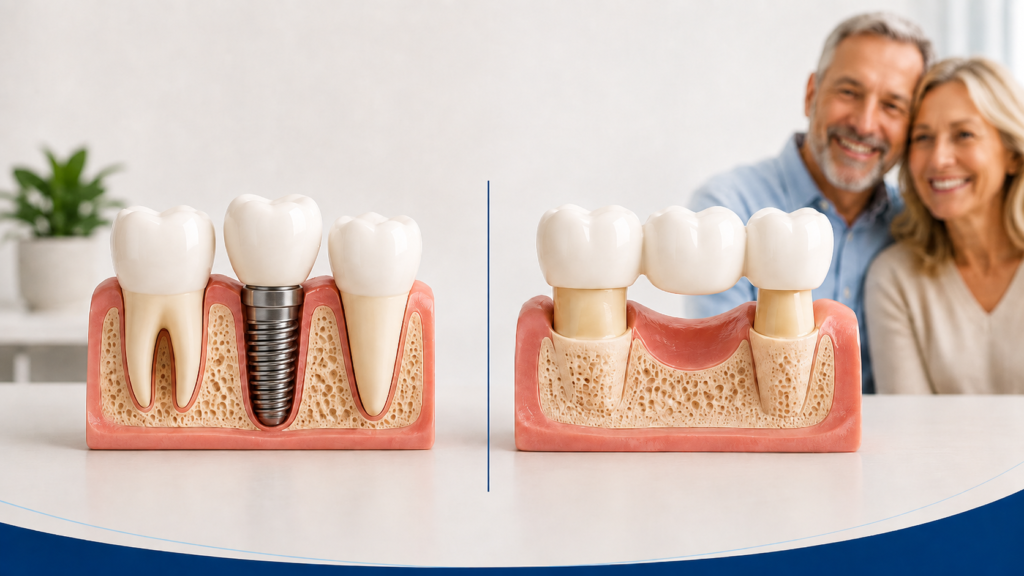
What Is a Dental Implant?
A dental implant replaces the missing root of a tooth.
The Canadian Dental Association describes a dental implant as an artificial root made from titanium that is inserted into the jawbone. Once the implant has healed and become stable, an artificial replacement tooth is attached to it.
For a single missing tooth, the restoration generally consists of three main components:
- The implant placed in the jawbone
- An abutment that connects the implant to the replacement tooth
- A custom-made artificial tooth or crown
Because the implant is supported by the jaw rather than the teeth beside the gap, the neighbouring teeth do not have to be filed down simply to support the replacement tooth. The Canadian Dental Association specifically identifies this as one reason a single implant may be considered when a missing tooth sits between two healthy teeth.
Beamsville Smiles offers dental implants for patients looking to replace missing teeth with a fixed restoration designed to look and function naturally within their smile.
What Is a Dental Bridge?
A dental bridge also replaces a missing tooth, but instead of replacing the root, it literally bridges the space between the remaining teeth.
A traditional bridge typically consists of an artificial tooth positioned in the gap with crowns attached to the natural teeth on either side. Those neighbouring teeth provide the support that holds the bridge securely in place. Unlike a removable denture, a fixed dental bridge is not removed by the patient.
To create a traditional bridge, the supporting teeth are prepared for crowns. Impressions are then taken so that a custom bridge can be made to fit your mouth. A temporary bridge may be worn while the permanent restoration is being created.
At Beamsville Smiles, crowns and bridges are designed to blend with the patient’s natural smile while restoring the appearance and function of damaged or missing teeth.
Dental Implants vs. Bridges: What’s the Difference?
Although both treatments can fill the same gap, the biggest difference is where the replacement tooth gets its support.
| Dental Implant | Traditional Dental Bridge | |
|---|---|---|
| Replaces the missing tooth root? | Yes | No |
| Supported by | An implant placed in the jawbone | Neighbouring natural teeth |
| Requires neighbouring teeth to be prepared? | Generally no for a single implant | Usually yes |
| Requires surgery? | Yes | Typically no |
| Healing period? | Usually required before the final restoration | Generally a shorter treatment process |
| Fixed or removable? | Fixed | Fixed |
| Daily care required? | Brushing, flossing and regular dental care | Brushing, flossing beneath the bridge and regular dental care |
The Canadian Dental Association notes that implant treatment can require several appointments and that the implant may take several months to heal and bond with the surrounding bone. A traditional bridge, by comparison, can commonly be prepared and placed over a smaller number of visits because an implant does not first need to integrate with the jawbone.
Neither option is automatically right for everyone.
What Are the Advantages of a Dental Implant?
For the right patient, dental implants offer several important benefits.
A Dental Implant Stands Independently
One of the most significant differences is that a single dental implant does not rely on the neighbouring natural teeth for support.
With a traditional bridge, healthy teeth on either side of the missing tooth usually need to be prepared for crowns. With an implant, those neighbouring teeth can generally remain untouched.
This can be particularly attractive when the teeth beside the gap are otherwise healthy.
It Replaces the Missing Tooth Root
A bridge replaces the visible portion of the missing tooth, while an implant also replaces the root beneath it.
The titanium implant is placed into the jawbone and acts as an anchor for the artificial tooth above it.
It Feels Similar to a Natural Tooth
Because the replacement tooth is anchored independently, dental implants are designed to function much like natural teeth. The Canadian Dental Association notes that implant-supported replacement teeth can look and act similarly to natural teeth.
Implants Can Be Used for Different Types of Tooth Replacement
Dental implants are not limited to replacing a single tooth.
Depending on the situation, implants can also provide support for bridges when several teeth are missing. The Canadian Dental Association describes implant-supported bridges as another treatment option when natural teeth are not suitable to support a traditional bridge or when multiple teeth are being replaced.
What Are the Advantages of a Dental Bridge?
Dental implants have benefits, but that does not make bridges obsolete. A dental bridge may be an excellent treatment option in the right circumstances.
A Bridge Does Not Usually Require Implant Surgery
Dental implants are surgically placed into the jawbone. A traditional tooth-supported bridge does not require implant placement, which may make it a consideration for patients who cannot or do not want to undergo implant surgery.
Treatment Can Be Completed More Quickly
Dental implant treatment includes a healing period while the implant bonds with the surrounding bone, which the Canadian Dental Association says can take several months.
A traditional bridge does not require this same healing phase. The supporting teeth are prepared, a custom bridge is made, and the final bridge can then be cemented into position.
A Bridge Can Restore Several Teeth Together
Bridges can be designed to replace one or more missing teeth depending on the location of the gap and the health of the supporting teeth.
Existing Teeth May Already Need Crowns
The fact that neighbouring teeth must usually be prepared is an important consideration with a traditional bridge. But every mouth is different.
If the teeth beside the gap are already heavily restored, damaged or in need of crowns for other reasons, your dentist may consider that as part of the overall restorative treatment plan.
The important point is that the condition of the surrounding teeth matters, which is one reason choosing between an implant and bridge requires an examination rather than a one-size-fits-all answer.
Who Is a Good Candidate for Dental Implants?
Not everyone with a missing tooth will automatically be able to have an implant.
According to the Canadian Dental Association, suitable candidates generally need:
- Good general health
- Healthy gums
- Enough jawbone to support the implant
If there is not enough bone available, bone grafting may sometimes be an option before or as part of implant treatment. Your dentist or dental specialist must assess whether this is appropriate for your particular case.
The implant assessment may include an examination along with dental X-rays to evaluate the teeth, jaw and proposed treatment area.
Your medical history, oral health and ability to maintain the implant also need to be considered before treatment begins.
Who May Be a Good Candidate for a Dental Bridge?
A traditional dental bridge generally requires suitable natural teeth beside the missing tooth because those teeth will support the restoration.
The Canadian Dental Association explains that traditional bridges are used when natural teeth are available on both sides of the gap. The type of bridge recommended depends on factors such as the location of the missing tooth and the condition of the patient’s teeth, mouth and gums.
If the neighbouring teeth cannot provide adequate support, your dentist may discuss another solution, including dental implants, an implant-supported bridge or another type of tooth replacement.
How Long Does a Dental Bridge Last?
There is no exact expiration date for a dental restoration.
How long a bridge remains successful depends on many factors, including the health of the supporting teeth, oral hygiene and regular professional care.
The Canadian Dental Association states that with proper care, a dental bridge can generally last about 10 years or potentially longer.
Daily cleaning is especially important because food and plaque can accumulate around the supporting teeth and underneath the artificial tooth. Your dental team can show you how to floss beneath the bridge properly.
How Do You Care for a Dental Implant?
Dental implants still require daily oral hygiene.
The Canadian Dental Association recommends brushing and flossing around implants and attending regular dental examinations so your dentist can monitor the implant, surrounding tissues and bite.
A replacement tooth cannot develop a cavity in the same way a natural tooth can, but the gums and tissues around an implant still need to remain healthy.
Good home care and ongoing professional dental care are therefore important whichever tooth replacement option you choose.
What About the Cost of Dental Implants vs. Bridges?
Cost can influence treatment decisions, but there is no useful single price that applies to every patient.
The total cost can depend on factors such as:
- How many teeth need to be replaced
- The type of restoration required
- Whether additional procedures are needed
- The health of the surrounding teeth and gums
- Whether bone grafting or other preparatory treatment is necessary
- Dental insurance coverage
The Canadian Dental Association notes that dental implants can cost more than some other forms of tooth replacement and may not always be covered by a dental plan.
Before beginning treatment, ask your dental office for an estimate based on your actual treatment plan and check your individual dental benefits to determine what may be covered.
So, Is a Dental Implant Better Than a Bridge?
Not necessarily.
The better question is:
Which option makes the most sense for your mouth?
An implant may be particularly appealing when:
- The teeth on either side of the gap are healthy.
- There is sufficient healthy jawbone to support an implant.
- You want to avoid preparing neighbouring teeth solely to support a bridge.
- You are comfortable undergoing implant treatment and its healing period.
A bridge may be worth considering when:
- Suitable teeth are available to support the restoration.
- You would prefer to avoid implant surgery.
- A shorter overall treatment process is important.
- The neighbouring teeth already require significant restorative treatment.
These are general considerations rather than rules. Your dentist needs to evaluate the missing tooth, neighbouring teeth, gums, bone and overall bite before recommending a treatment plan. The Ontario Dental Association likewise advises that a dentist is best positioned to recommend an appropriate option based on a patient’s individual needs.
What Happens at a Tooth Replacement Consultation?
If you have a missing tooth, the first step is not choosing an implant or bridge from a list online. It is finding out what options are actually appropriate for your mouth.
At a dental appointment, your dentist can assess:
- The location of the missing tooth
- The condition of the neighbouring teeth
- Your gums and surrounding tissues
- The amount and condition of the jawbone
- Your bite
- Your general oral health
- Your treatment preferences and goals
If dental implants are being considered, additional diagnostic imaging may be needed to determine whether there is adequate bone and to plan implant placement.
From there, your dentist can explain the options that apply to your particular situation.
Missing a Tooth? Explore Your Options at Beamsville Smiles
You don’t have to decide between a dental implant and dental bridge on your own.
At Beamsville Smiles Family Dentistry, our dentists provide both dental implants and crowns and bridges for patients with missing or damaged teeth. Our approach is based on your individual diagnosis, with treatment options discussed according to your specific case.
If you are looking for dental implants in Beamsville, considering a dental bridge or simply want to understand your options for replacing a missing tooth, book an appointment with our team.
Call Beamsville Smiles at (905) 563-6313 or request an appointment online.
Beamsville Smiles Family Dentistry is located at 4413 Ontario Street, Suite 203, Beamsville, Ontario, serving patients and families in Beamsville and the surrounding community.
Frequently Asked Questions About Dental Implants and Bridges
Is a dental implant better than a bridge?
Neither treatment is automatically better for every patient. Dental implants replace the missing tooth root and generally do not require neighbouring teeth to be prepared. Traditional bridges use adjacent teeth for support and do not usually require implant surgery. Your dentist can recommend an option based on your oral health, bone, neighbouring teeth and individual treatment needs.
Does a dental bridge damage the teeth beside it?
With a traditional bridge, the neighbouring teeth are prepared so crowns can fit over them and support the artificial tooth. This changes the tooth structure, which is why the condition of those teeth is an important consideration when comparing a bridge with an implant.
How long does it take to get a dental implant?
Dental implant treatment typically takes place over several appointments. After the implant is placed into the jawbone, healing and bonding with the surrounding bone can take several months before the final restoration is completed. The exact timeline varies by patient and treatment plan.
How long does a dental bridge last?
The Canadian Dental Association states that a well-cared-for dental bridge can generally last about 10 years or longer. Daily brushing, cleaning beneath the bridge and regular dental appointments are important for maintaining it.
Can I get an implant if I don’t have enough jawbone?
Possibly. Some patients with insufficient bone may be candidates for a bone graft to build up the area before or as part of implant treatment. Your dentist or dental specialist must determine whether this is appropriate for you.
Does Beamsville Smiles offer dental implants and bridges?
Yes. Beamsville Smiles Family Dentistry lists both Dental Implants and Crowns & Bridges among its restorative treatment options. Call (905) 563-6313 or request an appointment to discuss which tooth replacement options may be appropriate for you.